
Preaching the Divine
Are Jewish leaders comfortable talking about God? Are they talking about God at all?
Below are some insights into how Jewish clergy of varying denominations and ages feel about God-talk in their communities.

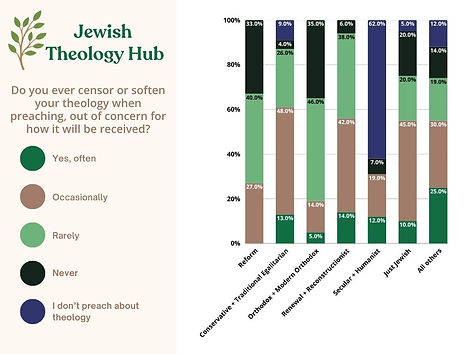
Summary of Findings
1. Diversity of Belief and Practice
-
Clergy represent a wide spectrum of theological perspectives, from strongly traditional and observant to humanistic, non-theistic, and secular approaches.
-
Many are comfortable with a non-literal, conceptual, or metaphorical understanding of God, often framing God as a character, narrative, or ethical framework rather than a supernatural being.
-
This diversity influences how clergy approach their teaching and preaching: they are often careful to validate multiple perspectives and avoid imposing their own beliefs.
Implication: American Jewish clergy operate in a pluralistic environment, where inclusivity and flexibility are essential for connecting with congregants.
2. Emphasis on Validation and Inclusivity
-
Many clergy explicitly prioritize validating congregants’ perspectives, encouraging personal reflection, and normalizing questioning and doubt.
-
Validation is the most common strategy when discussing God with congregants, with practice-focused or exploration-focused strategies also prominent.
-
Hesitations often stem from wanting to respect diversity and not alienate those with different theological backgrounds.
Implication: Clergy see their role as facilitators of exploration, rather than solely as transmitters of doctrine.
3. Focus on Personal and Experiential Learning
-
Clergy frequently rely on their own God relationships, personal study, and peer discussions to inform their teaching.
-
Goals often include deepening spiritual connection, providing theological literacy, and encouraging reflection.
-
Many use texts (Torah, rabbinic writings) as a springboard for discussion, not as prescriptive authority.
Implication: Clergy value ongoing personal and professional development, seeing their own learning as central to their effectiveness.
4. Challenges in Teaching About God
-
Common challenges include:
-
Audience diversity: differing beliefs, ages, cultural backgrounds.
-
Complexity of theology: abstract or philosophical topics, reconciling God’s nature with historical events or trauma.
-
Language barriers: congregants may lack the vocabulary to articulate beliefs or doubts.
-
Balancing honesty with inclusivity: clergy hesitate to impose personal views while still giving meaningful guidance.
-
-
Less frequent challenges: alienation, theological binaries, or difficulty handling secular skepticism.
Implication: Teaching about God requires careful communication, cultural sensitivity, and adaptability. Clergy must balance authenticity with inclusivity.
5. Desired Support and Resources
-
Most common requests:
-
Peer discussion and collegial engagement (especially cross-denominational).
-
Teaching materials that summarize Jewish approaches to God.
-
Opportunities for personal exploration and study, including chevruta or formal classes.
-
Implication: Professional development should focus on collaborative, discussion-based, and resource-oriented approaches, rather than prescriptive
“how-to” manuals.
6. Overall Portrait of American Jewish Clergy
-
Pluralistic: Skilled at navigating multiple theological perspectives.
-
Reflective: Focused on personal growth and congregant engagement rather than rote transmission.
-
Inclusive: Prioritize validation, exploration, and non-dogmatic approaches.
-
Resource-conscious: Seek structured materials and collegial support to strengthen confidence.
-
Adaptive communicators: Skilled at translating complex or abstract theological concepts into accessible language.
Bottom line:
American Jewish clergy are thoughtful, adaptive, and highly pluralistic educators. Their work is both pastoral and pedagogical, aiming to support spiritual growth while respecting the diversity of congregants’ beliefs. Challenges are less about their own understanding and more about audience needs, communication, and navigating diversity.